Forgot Password?
Mobile number is now mandatory for the security of your account.
We've sent you a verification code on your mobile number. Please enter it here to set a new password.
We've sent you a verification code on your mobile number or email address. Please enter it here to set a new password.
The speed of overtaking and overtaken vehicles are at 70 kmph and 40 kmph respectively. Determine overtaking sight distance. Take
c. A vane apparatus 10cm long and 8cm in diameter was passed into the soft clay, at the bottom of borehole test. A torque of 45N-m was applied at which failure took place Subsequently vane instrument rotated rapidly, so as to get remolded soil sample. This remolded soil was sheared at a torque of 18 N-m. Then calculate sensitivity of clayey soil.
c. Draw a typical cross section of a permanent way. Discuss in brief'the basic functions of various components of railway track.
a. Define foundation and enumerate the objectives of the foundations.
b. What is safe bearing capacity of soil? List the types of methods adapted to examination of ground and explain any two of them,
c. List the types of foundation and explain any two of them with neat sketches.
4. Explain the classification of stone masonry with neat sketches.
b. Explain: i) Queen closer ii) King closer, with nest sketch
c. Explain the following:
i) English Bond
ii) Flemish Bond
ii) Cavity walk
a. Write a neat diagram of segmental arch and label it.
b. List the classification of arches and explain any one of them in detail.
C. Write short notes on:
iv) Lintels
c. Write short notes on:
i) Chejja
ii) Canopy
iii) Balcony
a. Define a pitched roof and explained various types.
b. Give a list of materials which are Commonly used as floorings and give a brief description of any four of them in detail.
a. Explain with neut sketches of i) Ledged and braced doors ii) skylights.
b. Discuss the provision of doors and windows with respect to the following:
i) Location ii) Size.
c. Explain the properties of materials used in doors and windows.
a. Explain requirements of a good staircase.
b. List the types of stairs and explain with neat sketches of Dog-legged stairs and circular dtairs.
The inside dimensions of a stair case in a residential building are 2.0 m x 4.60 m. The height W of floor is 3.30 m and the roof consists of RCC slab is 12 cms thickness. Design a proper layout of dog legged staircase for this building.
a. Mention the tools which are required in the plastering work.
b. Enumerate the defects found in plastering work.
c. Explain briefly painting on different surfaces.
a. Differentiate between the following:
i) Formwork and Scaffolding ii) Damp-proofing and Waterproofing.
b. Write short notes on :
i) Form work for columns
ii) Effects of dampness
a. Define EIA and explain relationship between EIA, EIS and FONSI.
b. Explain in brief baseline information in EIA.
a. Explain the following:
i) Need for EIA studies
ii) Limitations of EIA
b. Explain in detail, the step by step procedure for conducting EIA.
a. Explain any 2 methodologies used in EIA.
b. Define environment setting. List the major environment components to be considered during EIA and explain any one of them.
a. Explain the basic step for prediction and assessment of impact on water.
b. Discuss the various steps involved in assessment and prediction of impact on air attribute.
a. Differentiate between REA and CEIA. List the brief contents of REIA.
b. Bring out clearly the guidelines of Ela for a development project substantiate with an example.
a. What is the importance of public participation in environmental decision making? State the advantages and disadvantages of public participation.
b. Outline the salient features of project activity and environmental parameters relationship.
a. Distinguish between :
i) Domestic and industrial wastewater
ii) Stream standards and effluent standards.
b. Explain the effects of discharge of industrial wastewater on streams.
a. Explain self purification of steams with sag curve.
b. A city discharges 100 cumecs of sewage into a river, wher' is fully saturated with oxygen and flowing at the rate of 1500 сumecs during its learn stays with a velocity of 0.1 m/sec. The 5-days BOD of sewage at the given temperature is 280 mg/L. Find when and where the critical D.O. deficit will occur in the downstream portion of the river and what is its amount. Assume co-efficient of purification of stream as.4.0 and KD as 0.1.
a. What is meant by strength reduction? Explain the various methods of strength reduction.
b. What is neutralization of industrial Wastewater? Explain the common methods adopted forneutralization.
a. List and explain the methods of removal of colloidal solids.
b. Explain the method adopted for treatment and disposal of sludge solids.
a. Write an explinatory note on feasibility of combined treatment of industrial waste with domestig waste
b. Explain the effects of discharge of raw and partially treated wastes to streams.a
a. comment on the characteristics and treatment of wastewater from a sugar industry.
b. With the help of a line diagram explain the process of tanning industry highlighting the sources of wastewater generation.
a. With the help of a flow diagram explain the treatment units suggested to treat Wastewater from a steel industry along with wastewater characteristics.
b. State the origin and characteristics of the wastewater from dairy industry.
a. With the help of a line diagram explain the process of paper and pulp industry highlighting the sources of wastewater generation.
b. Discuss the characteristics and treatment of wastewater from a pharmaceutical industry.
a. Enumerate the importance of Bogue's compounds in ordinary port land cement.
b. Explain briefly Theology of concrete. What are the factors affecting the rheology of concrete?
c. What are the factors affecting strength and elasticity of concrete?
a. Explain the mechanism of 'deflocculation' of cement particles by super plasticizers with neat sketches
b. What is optimum dosage of super plasticizer? How do you determine the optimum dosage of super plasticizer?
c. What are mineral admixtures? Explain briefly, i) Silica flume ii) G.G.B.S. iii) Fly ash.
a. Explain the factors affecting the mix design of concretes.
b. Design a concrete mix of Mas grade for the following data:Max size of aggregate - 20 mm; Crushed angular Min/max cement content - 300/450 kg/m'; Max W/C -0.5; Exposure condition - Moderate; Work ability - 100 mm slump: Method of placing - pumping: Quality control-good; Type of chemical admixture - Super plasticizer (Specific gravity - 1.14). Assume 25% replacement of cement by fly ash. Test data for materials:
i) Cement - OPC 43 grade IS 8112.
ii) Specific gravity of cement - 3.15 t
ii) Fly ash-20% Cementations material
iv) Specific gravity of fly ash-2.20
v) Specific gravity of coarse aggregate - 2.60
vi) Specific gravity of fine aggregate - 2.65 [belongs to zone II]
Assume any other data suitably.
a. Explain the role of transportation in the development of the country.
b. What are the significant recommendations of Jayakar committee? How are they implemented?
c. Explain the objectives of,
(I) CRRI
(i) IRC
(ii) HRB
(iv) CRF
a.Explain
(i) Saturation system c.
(ii) Road patterns
b. 3 new roads P. O. R are to be completed in a district during a five year plan period. Using the data given below work out the order of priority for phasing the plan program by the principle of maximum utility per unit length. Adopt utility unit of 0.5, 1.0, 2.0 for population ranges & 1.0 for 1000t of agricultural products or 100t of industrial products respectively.
a. Explain the various elements of road margin.
c. What is the necessity of realignment? List the steps in the realignment.
b.The design speed of a road is 65 kmph, the coefficient of friction is 0.36 and reaction time of driver is 2.5 sec. Calculate the values of, (i) HSD, (ii) ISD required for the road.
c. Calculate the super elevation to be provided for a horizontal curve with a radius of 400 m for a design speed of 100 kmph in plain terrain comment on the results. What is the coefficient of lateral friction mobilized if super elevation is restricted to 0.07?
a. Explain the necessity of providing transition curve and also define transition curve.
b. The speeds of overtaking and overtaken vehicles on a 2 way traffic road are 90 kmph and 60 kmph respectively. The acceleration of overtaking vehicle is 0.95 m/sec2.
(i) Calculate safe overtaking sight distance.
(ii) Mention the minimum length of overtaking zone
(iii) Draw a neat sketch of the overtaking zone. Show the position of sign posts.
c.A valley curve is formed by a descending grade of 1 in 25 meeting an ascending grade of I in 30. Design the length of valley curve to fulfill both comfort condition and head light sight distance requirements for a design speed of 80 kmph. Assume allowable rate of change of centrifugal acceleration C =0.6 m/sec.
a. List and explain the desirable properties of subgrade soil.
b. List the desirable properties of bitumen and tests to be conducted to bitumen.
c. Explain with a neat sketch how the plate load test is conducted to determine the modulus of subgrade reaction of soil.
a. Explain the significance of ESWL in pave design.
b. Design the flexible pavement for construction of new highway with the following data:Number of commercial vehicles as per last count-1000 CV.
Period of construction = 3 yrs.
Annual traffic growth rate=8%
Design CBR of subgrade soil = 10%
Category of road NH, 2 lane single carriage way.
Design life 15 yrs.
c. Design the pavement slab thickness by IRC method using the following data:
Modulus of Subgrade reaction = 8 kg/cm3
Design wheel load (P) = 5100 kg
Present traffic intensity=1000 evd
Radius of contact area = 15 cm
Highway is South Tamil Nadu t=17.6
a. Differentiate between seal coat and prime coat.
b. Explain the construction steps for cement Concrete pavement slab.
c. The maximum quantity of water expected in one of the open longitudinal drains on clayey soil is 0.9 m/sec. Design the cross section and longitudinal slope of trapezoidal drain assuming the bottom width of trapezoidal section to be 1.0 m and cross slope to be 1.0 vertical to 1.5 horizontal. The allowable velocity of flow in the drain is 1.2 m/sec and Manning's roughness coefficient is 0.02.
a. Write a note on types of failures in flexible pavement.
b. Write a note on benefit cost ratio method BOOT concept.
c. Compare the annual costs of 2 types of pave structures,
(i) WBM with thin Bituminous surface at total cost of 2.2 lakhs per km, life of 5 years, interest at 10%, salvage value of 0.9 lakhs after 5 years, annual average maintenance cost of 0.35 lakhs per km and
(ii) Bituminous Macadam base and bituminous concrete surface total cost of 4.2 lakhs, life of 15 years, interest at 8%, Salvage value of 2.0 lakhs at the end of 15 years, annual average maintenance cost of 0.25 lakhs per km.
a. Explain the graphical method for the determination of the required storage capacity of are servoir when the demand is i) Uniform ii) Non-uniform.
b. Write short notes on the following:
i) Flood control reservoir
ii) Distribution reservoir
iii) Multipurpose reservoir.
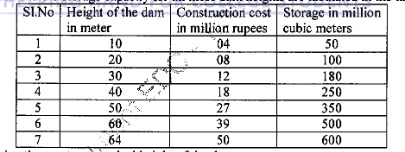
c. The construction costs for certain possible heights of a dam at a given site have been estimated and the storage capacity for all these dam heights are tabulated in the table below:
Determine the most economical height of the dam (04 Marks)
a. Define Gravity dam. Explain with neat sketch the drainage galleries in gravity dam.
b. Following data were obtained from the stability analysis of a concrete gravity dam
i) Totál overturning moment about toe = 1.1 x 10⁶ kN-m. (09 Marks)
ii). Total resisting moment about toe = 2.1 x 10⁶ kN-m.
iii) Total vertical force about base = 54,000 KN.
IV) Base width of the dam = 50m.
v) Slope of the D/S face = 0.8H:IV.
Calculate the maximum and minimum vertical stress to which the foundation will be subjected to, what is the maximum principal stress at toe? Assume there is no tail water.
a. Explain the two different methods which are adopted for constructing earthen dams. Which of these methods would you prefer and why?
b. What precautions and remedial measures would you undertake to control the seepage through, i) Earthen dam body ii) The dam foundation.
Design a surplus weir for the following data : Combined catchment area - 51km2 ;Intercepted catchment area = 46km2 ; Top bund level (TBL) = 100.00m; Maximum water level (MWL) = 98.50 m ; Full tank level (FTL) = 97.5m; Average ground level at proposed site=96.5m ; Top width of tank bund =2m ; Side slopes of bund on either side = 2:1 ; Level of hard strata for foundation = 95,00n; The ground level below the weir (D/S of weir) slopes to a level of 95.50m in distance of about 6m. Ryve's co-efficient C = 8; Modified Ryve's coefficient C = 2.5.
Provisions may be made to make Kutcha regulating arrangements to store water upto MWL in terms of necessity
Draw to a suitable scale the following views of the above designed-surplus weir.
a. Cross section of weir.
b. Draw half longitudinal section and half longitudinal elevation.
c. Draw half plan at foundation and half plan at ground level
Design a canal regulator cum-road bridge with the following particulars:
Hydraulic particulars of canal upstream : Full supply discharge = 20m3/sec ; Bed Width = 15m ; Bed lovel = 20.0m ; Full supply depth =2.0m; Full supply level = + 22.0m Top level of bank = + 23.0m. The right bank is 5m wide and left bank is 2m wide. Hydraulic particulars of canal downstream : Full supply discharge = 16m/sec ; Bed Width = 15m; Bed level = + 200m ; Full supply depth = 1.75m ; Full supply level = +21.75m; Top level of bank = + 22.75m. Top width of banks are the same as those on the upstream side. The regulator carries a road way single lane designed for LR.C loading class 'A'. Provide clear freeboard of one moter above F.S.L for road bridge. Good foundation soil is available at +19.00. Assume the ground level site as +22.00. The co-efficient of drawing ratio for 80% is 1.645, 85% is 1.58 and 90% is 1.358. Draw:
a. Cross section showing half elevation and half section.
b. Longitudinal section.
c. Half plantat foundation and half pan at ground level.
a. Derive the expression for normal stress and write the comparison equations in y and z directions.
b. Derive the differential equations of equilibrium for a 3 - dimensions system in Cartesian coordinate.
a. At a point P in a 3-D system the rectangular stress corushents are =1; = -2; =4; =2; = -3 and = 1 all units are in KP Find the principal stresses and check for invariance.
b. The displacement field in micro units for a body is given by u = (x2 + y)i + (3+2)j + (x2+2y)K. determing the principal strains at (3, 1, -2) and the direction of the minimum principal strain.
a. Write a note on strain Rosette. By means of strain rosette, the following strains were recorded during the test on a structural member.determine: i) Magnitude of pincipal strains
ii) Orientation principal planes.
b. Write a note on:
i) Plane stress problem
ii) Plano strain problem
iii) Mohrs circle.
Find the expressions of stress for a bending of simply supported beam subjected to uniformat distributed loading.
a. drive the parital differential equations of equilibriumin polar coordinates for 2- dimensional system.
b. Check if represents a stross function.
A. Define axlsymmetric problem with example.
b. Derive Lame's equation for thick cylinders.
Discuss the effect of circular hole on the stress distribution of retangular plate.
a. Show that the stress function satisfy for torsion problems.
b. Write short notes on
i) St. Venant's principle
ii) Airy's stress function
a. Explain the need and importance for planned water supply scheme to town.
b. Define per capita demand and explain various factors that affect the per capita demand.
c. The population data of a town are given below:
Estimate the expected population in the year 2050 by Geometric Increase Method.
a. Enumerate the different surface and subsurface sources of water and compare the quality and quantity and suitability of various sources.
b. What is an intake structure? What are the factors governing the selection of site for locating an intake.
c. Explain with a neat sketch of a reservoir intake.
a. Explain the different physical, chemical and bacteriological tests conducted on water.
b. Mention the max. permissible limits as per BIS of the following water quality parameters and write the problem caused if the limit is exceeded.
(i) Hardness (ii) pH (iii) Fluoride (iv) Turbidity
c. Explain various waterborne diseases and their control.
a. With the help of a flow diagram, explain briefly the complete sequence of a water treatment plant.
b. Explain with a sketch how the optimum coagulation dosage is determined in the laboratory.
c. Design a circular sedimentation tank to treat 10 MLD of water, given the following data:
Depth of liquid = 3.5 m Detention time = 4 hr.
Calculate, also over flow rate.
a. Explain the theory of filtration.
b. Compare slow sand filters with Rapid sand filters.
c. What is meant by disinfection in water treatment? Give the requirements of an ideal dsinfectant.
a. List the different forms of chlorination and explain any two of them.
b. Write a note on fluoridation and defluoridation.
c. Explain the zeolite methods of water softening.
a. Explain the environmental significance of hardness in water.
b. Explain methods of water softening to remove permanent hardness of water.
c. Calculate the hardness of given water sample data:
Na2+ = 30 mg/L Cl = -54 mg/L
Ca2+ = 20 mg/L Sr-= 04 mg/L
Mg2- = 15 mg/L Turbidity =50 mg/L
Comment on the result.
Write short notes on the following
a. Defluoridation
b. Pressure filters
c. Iron and Manganese removal
d. Removal of Taste & odour
e. Activated Carbon treatment.
a. Discuss the need for protected water supply.
b. Explain the various factors that govern the selection of a particular source of water in formulating a town or city water supply scheme.
c. Explain water bome diseases. What are the precautionary measures to be taken for control of the communicable diseases?
a. What are the advantages and disadvantages of centrifugal pumps and reciprocating pumps?
b. Explain the following:
ii) Break point chlorination
Explain the following:
i) Plain chlorination
iii) Super chlorination
c. Distinguish between fluoridation and defluoridation. Explain any one method of defluoridation in detail.
a. Briefly explain the following methods of Might soil disposal with neat sketches :
i) Aqua privy ii) Two-pit latrine.
b. Explain the Septic Tank with neat sketch. Also Highlight advantages and disadvantages.
c. With neat sketch, explain soak pit.
a. Explain :
i) Concept of Eco-sanitation.
ii) Sources of ground water pollution
b. What is Rain water harvesting? Explain suitable methods of rain water harvesting in rural areas.
a. Define the following as referred to communicable diseases: i) Epidemic ii) Endemic iii) Vehicle of Infection iv) Vaccination v) Isolation
b. Discuss the general methods of communication of communicable diseases.
a. Describe the following methods of disposal with advantages and disadvantages : i) Dumping ii) Incineration iii) Salvaging.
b. Explain with a neat sketch Bio plant in detail.
a. Explain all the essentials necessary to obtain the objectives of milk sanitation,
b. Define Pasteurization. Explain any one method of pasteurization, with a sketch.
a. Discuss the different diseases transmitted by the mosquito.
b. Briefly explain control of nuisance mosquitoes.
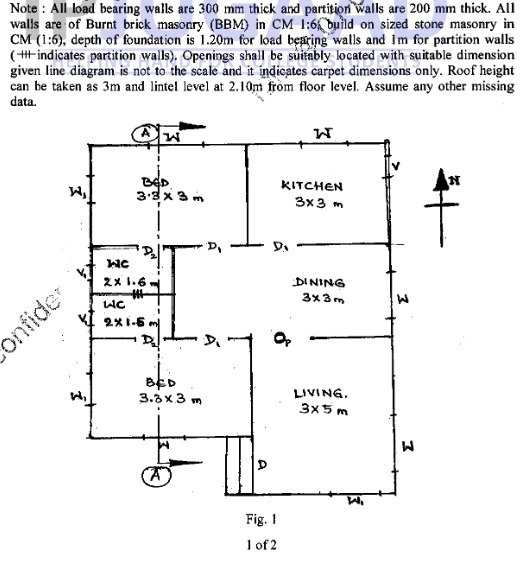
Line diagram of residential building is given in Fig Q1. Draw to a scale of 1:100
a. Plan at sill level
b. Front Elevation
c. Section at A-A
d. Schedule of openings
Draw plan and sectional Elevation of a RCC isolated sloped footing with the followingn details.
a) Size of column= 350 x 500 mm
b) Size of footing =2 x 2.5 m
c) Depth of foundation below GL=1.2 m
d) Thickness of PCC (1:3:6) = 75 mm
e) Depth of footing = 600mm @ face of column
=200mm @ edge of footing
Reinforcement details.
Column - 8 number of 160 bars - main rft.
and lateral ties of 8mm bars @ 200C/C.
Footing - 12 mm bars at 120 mm C/C both ways.
Draw the front elevation, sectional plan and sectional elevation of 3 pane led single shutter door of size 1.2 x 2.1 m
Prepare a bubble diagram and develop a line diagram for a primary health centre to a suitable scale.
Prepare the water supply and sanitary layout for a residential building shown in Fig. QI with suitable notations.
a. Find the shear force at 'x' using influence line diagram, for the beam show in Fig. Q1(a)
b. A train of Five wheel loads crosses a simple span of 30 meters. Calculate the maximum positive and negative shear at midspan and the absolute maximum bending moment anywhere in the span
Analyse the frame shown in Fig Q2 by using slope deflection method. Draw BMD and SFD.
Analyse a continuous beam shown in Fig 23. Using moment distribution method. Sketch SFD and BMD. (El constant).
Analyse the frame shown in Fig 04 by moment distribution method. Draw the banding moment diagram. (El constant).
Analyse the frame in Fig Q5 by Kani's method. Draw the bending moment diagram.
Analyse the frame shown in Fig. Q6 by using Flexibility matrix method. Use system approach. Draw BMD.
Analyse the continuous beam shown in Fig. 27 by using stiffness matrix method. Use system approach Draw BMD.
a. Explain degrees of freedom, free vibration, natural frequency and damping.
b. Determine natural frequency and period of the system as shown in Fig. Q8(b).
Take and
a. Discuss in brief, the different branches of geology which are related to civil engineering.
b. Write the chemical composition, crystal system and uses of any two of the following minerals - Agate , Orthoclase feldspar. Talc, Calcite.
c. Discuss in brief, the different discontinuities traced within the earth's interior.
a. Write the forms of igneous bodies with neat sketches.
b. Write the role of metamorphic agents in metamorphism.
c. Write a brief note on Exogenous and Endogenous geological agents.
a. Write a brief note on soil profile. Discuss the factors which contribute for the formation of soil.
b. Discuss Mcanders and Oxbow lake, with neat sketches.
c. What is Unconformity? What is its significance in civil engineering?
a. What is an Earthquake? Discuss the preventive measures to be taken during construction of building in seismic zones?
b. Discuss the different seismic zones of India.
c. Explain the causes and effects of an Earthquake.
a. What are the qualities that are required for the selection of rocks as construction materials?
b. Define Fault. How are they formed and their effects in civil engineering?
c. Write a brief note on Joints in rocks and their significance in a reservoir site.
Critically examine the following with suitable reason :
a. Sedimentary rock dipping downstream are ideal for dam sites.
b. Reservoir along the course of effluent streams are better than those on the valleys or influent rivers. Justify
c. Stability of a tunnel alignment along a scismic zone.
d. Silting up of reservoir is a good sign for the safety of the dam.
a. Write a brief note on water dousing or superstitious method of finding water.
b. What is an Aquifer? Write a note on confined and unconfined aquifor, with a neat sketch.
c. What is Rain water harvesting? Discuss the various types of artificial recharge.
a. What is Remote Sensing? Discuss its applications in civil engineering.
b. Write a note on impact of mining on environment.
C. What is GIS? Write its use in civil engineering.
a. Describe any five field tests that can be done on cement.
b. Draw a flow chart for the manufacturing of cement by wet process.
a. What do you understand by grading analysis? Explain how it is done for fine aggregates.
b. Mention the maximum impact value for wearing and non-wearing surfaces and also explain how impact test is done for coarse aggregate.
a. What is workability? Explain its importance in fresh concrete
b. List out any ten methods adopted for transportation of concrete.
a. Explain the flocculation and de-flocculation of cement grains under the influence of superplasticizer, with the help of a diagram
b. Briefly explain the effect of fly ash on fresh and hardened concrete.
a Discuss any five factors affecting the strength of concrete.
b. Discuss any five factors affecting the strength test results.
a. List out any ten factors contributing to cracks in concrete.
b. List out any five methods each for controlling sulphate attack and corrosion of steel due to chloride attack
Write short notes on the factors affecting the following:
a. Modulus of elasticity
b. Shrinkage
c. Creep
d. Workability
With the help of the following design stipulations and test data for materials design a M20 grade concrete: a. Design stipulations:
i) Characteristic compressive strength at 28 days = 20 N/mm2
ii) Maximum size of aggregate =20 min (angular)
iii) Degree of workability = 0.90 compacting factor
iv) Degree of quality control = good
v) Type of exposure =mild
b. Test data for materials:
i) Specific gravity of cement =3.15;
ii) Specific gravity of coarse aggregate = 2.60
iii) Specific gravity of fine aggregate = 2.60;
iv) Water absorption of coarse aggregate = 0.5% ;
v) Water absorption of fine aggregate = 1.0% ;
vi) Free moisture in coarse aggregate = Nil;
vii) Free moisture in fine aggregate = 2.0% ;
viii) Grading of fine aggregate = Zone III
Any missing data may be suitably assumed.
List out the various sources of water that is available on the earth and explain.
How do you protect new wells from contamination? Give step by step procedure.
Write down the drinking water quality standards for the following:(i) pH ii) Chlorides ii) Nitrates iv) Fluoride and v) Total Hardness.
Comparison between Reciprocating pumps and Centrifugal pumps.
Explain any five disinfecting methods for water.
What are the main objectives of Rural sanitation in villages? Brief out.
With the aid of neat sketches, describe the following types of latrines i) Pit Privy and ii) Aqua Privy,
Elaborate the composting methods practiced in rural areas on the mixture of night soil and refuse.
How does one can practice Roof-top rain water harvesting? Explain.
Define i) Infection ii) Epidemic.
Explain the Epidemiologic cycle.
What are the types of collection and transportation systems adopted for refuse? Explain.
Brief out the methods of disposal of refuse in rural areas.
With the aid of neat sketch, write a note on Bio-gas plant.
Write down and explain the essentials of a milk sanitation.
Mention the types of pasteurizing the milk and describe them.
Write short notes on Mosquito related diseases.
Write short notes on Deflouridation Technique.
Write short notes on Break point chlorination.
Write short notes on Trench composting.
Write short notes on Advantages and disadvantages of separate system and water carriage system.
What is PCU? What are factors affecting PCU values?
The following data were obtained from the spot speed studies carried out at stretch of highway during a certain period of time. Suggest 1) Speed limit for regulation of traffic. ii) Lower speed group causing congestion. iii) Speed for design of geometric elements.
List the payment surface characteristics and explain briefly.
Write a note and mention IRC standards:i) Width of formation ii)Right of way-IRC only for open areas.
Derive an expression for overtaking sight distance.
Find the minimum sight distance to avoid head-on collision of 2-cars approaching at 90 kmph and 60 kmph. Given t = 2.5 secs, f = 0.7 and Brake efficiency of 50% in either case.
Write a design procedure of evaluating super elevation as per IRC.
A state highway passing through a rolling terrain has a horizontal curve of radius equal to ruling minimum radius. Design all the geometric features of the curves. Assume: V=80 kmph, No. of lane = 2 and l = 6 m.
Define Gradient and its types.
A vertical summit curve is formed at the intersection of two gradients, +3.0 and - 5.0 percent. Design the length of summit curve to provide a stopping sight distance for a design speed of 80 kmph. Assume data as per IRC.
A valley curve is formed by a descending grade of 1 in 25 meeting an ascending grade of 1 in 30. Design the length of valley curve to fulfil both comfort and head light sight distance requirements for a design speed of 80 kmph. Assume allowable rate of change of centrifugal acceleration
Define unchannelised and channelized intersections. Write a neat sketch, of typical unchannelised and channelized intersections.
What is intersection at grade? Explain the basic requirements of intersection at grade.
What are grade separated intersection? Explain their advantages.
What is rotary intersection? Explain the design factors of rotary.
What is highway drainage? Explain its requirements.
The maximum quantity of water expected in one of the open longitudinal drains on clayey soil is Design the cross section and longitudinal slope of trapezoidal drain assuming the bottom width of the trapezoidal section to be 1.0 m and cross slope to be 1.0 vertical to 1.5 horizontal. The allowable velocity of flow in the-drain is 1.2 m/sec and Manning's roughness co-efficient is 0.02.
a. Critically define the terms void ratio, porosity and water content with phase diagram.
b. Derive the relation, with usual notations.
c. In an earthen embankment under construction, the bulk unit weight is 16.5kN/m3 at water content 11%. If the water content has to be increased to 50%, compute the quantity of water to be added per cubic meter of soil. Assume no change in void ratio. Also determine 'e' at this water content taking G = 2.65.
a. Define relative density of sand and list its importance in geotechnical engineering.
b. Describe consistency of soil. List and define consistency limits.
c. The following results are obtained by conducting liquid limit test on clayey soil in the laboratory :
Plot flow curve. Determine Liquid limit, Toughness index. Assume plastic limit=20%.
a. Explain with the help of typical particle size distribution curve, well graded, poorly graded and gap graded soil.
b. With the neat sketch, explain structure of clay minerals.
c. Following results are obtained from the laboratory tests conducted on two soil samples:
Show the positions of these soils on plasticity chart and classify as per I.S. system.
a. Derive the relation between co-efficient of permeability and percolation with usual notations.
b. Explain Quick - sand phenomena and list its importance during construction.
C. A falling head permeater accommodates a soil sample of 6cm length and 500cm2 in area.The permeability of sample is expected to be 1 x 10⁻⁶ cm/sec. Head of water in the standpipe falls from 30cm to 10cm in 40 minutes. Determine the size of the stand pipe which should be used.
a. Explain sensitivity and thixotropy of clayey soil.
b. List the factors affecting shear strength of soil.
c. A direct shear test results are obtained as follows:
Determine shear parameters graphically. Also draw Mohr's circle corresponding to second test result and report major and minor principal stresses.
a List the factors affecting compaction of soil and explain any 2 in detail.
b. List and explain various types of field compaction equipments.
c. The results of standard compaction test conducted in the laboratory are tabulated as follows:
Find MDD and OMC with usual notations by plotting compaction curve. Also draw ZAVD - line assuming G =2.65.
a. State the assumptions of one-dimensional Terzaghi's theory of consolidation. Also write standard / general differential one-dimensional consolidation equation with usual notation.
b. Explain with neat sketch, determination of co-efficient of consolidation by square root of time fitting method.
c. A layer of soft clay is om thick and dies under newly constructed building. The weight of sand overlying the clayey layer produces a pressure of 260 kN/m2 and this new construction increases the pressure by 100kN/m2 If the compression index is 0.5, compute settlement of soil layer given water content 40% and G=2.65.
a Critically discuss limitations of direct shear test.
b. Explain Vane shear test with neat sketch along with relations.
a. Define repeating variable. What are the guidelines for selection of repeating variables?
b. The resistance due to wind on a tall vertical Chimney is dependent on the density .viscosity of air, wind velocity V, diameter D and height H of the Chimney. By means of -theorem develop an expression for the resistance of the building in terms of these quantities.
c. A spillway model is constructed in the laboratory such that velocity and discharge in the model are respectively 2m/s and 2.5m3/s. If the velocity in the prototype is 20m/s, what is the scale ratio of the model and the discharge in the prototype?
a. Distinguish between open channel flow and pipe flow.
b. Show that for most efficient triangular channel section, the crest angle will be 90°.
c. A trapezoidal channel with side slopes 1:1 has to be designed to convey 10m3/s of water so that the amount of lining is minimum. Find the dimensions of channel. Take n = 0.015 and channel bed slope is 0.00056.
a. Derive the dynamic equation for non uniform flow in open channel:
b. In a horizontal jump on a horizontal floor, the Froude number before jump is , find Froude-number after jump.
b. In a horizontal jump on a horizontal floor, the Froude number before jump is , find Froudo-number after jump.
c. A 3m wide rectangular channel carries 2.4m3/s discharge at a depth of 0.7m. Determine
i) Specific energy at 0.7m depth; ii) Determine critical depth; iii) Determine alternate depth to 0.7m.
a. A jet of water with velocity 'v' strikes a series of flat vanes moving with velocity 'u' in the direction of jet. The vanes are held normal to the jet. Show that the maximum efficiency of jet is 50%
b. A square plate weighing 100N and of uniform thickness has side 20cm and it can swing freely about the top edge. A horizontal jet 2cm diameter and velocity 12.5 m/s impinges on the plate. The center of the jet is 15cm below the hinge. The jet strikes normal to the plate. Calculate:
i) What horizontal force must be applied to the bottom of plate to hold the plate vertical?
ii) If the plate is allowed to swing freely, what is the angle of inclination made by the plate with vertical with the force removed?
a. PART-B Show that the maximum efficiency for the jet striking a single semicircular vane symmetrical about the axis of the jet moving in the direction of jet is 16/27.
b. A jet of water moving at 30m/s impinges on a series of vanes moving with a velocity of 15m/s. The jet makes an angle of 30° to the direction of motion of vanes when entering and leaves at an angle of 120° to the direction of motion of the vanes. Draw the velocity triangle at inlet and outlet and find: i) the angle of vane tips at inlet and outlet, ii) the work done per N of water and iii) hydraulic efficiency. .
a. Give the list of classification of turbines with example.
b. Design a Pelton wheel turbine required to develop a power of 1500 kW working under ahead of 160m at a speed of 400rpm. The overall efficiency may be taken as 85%. Take Cv =0.98 and Cc =0.46. Jet ratio = 12.
a. Explain cavitation in turbines. How to prevent it?
b. Define draft tube and explain its function.
c. A Kaplan turbine runner is to be designed to develop 7350 kW power under a head of 5.5 m.Determine: 1) Diameter of runner and boss; il) Speed; iii) Specific speed. Take diameter of boss = of runner, speed ratio= 2.09 and flow ratio =0.68, = 85%TS
a. Define:
i) Manometric head;
ii) Static head;
ii) Suction head;
iv) Delivery head
b. What is the minimum starting speed of a centrifugal pump? Derive an expression for the same.
c. A centrifugal pump is to deliver 0.12 m3/s at a speed of 1450 rpm against a head of 25 m. The impeller diameter is 250 mm, width at outlet is 50 mm. The manometric efficiency is 75%. Determine the vane angle at the outer periphery of the impeller.
a. Define the following:
i) Tendon
ii) Pretensioning
iii) Post tensioning
iv) Load balancing
b. Explain how PSC is more advantageous as compared to RCC.
c. Explain with neat sketch, Freyssinet system of post tensioning.
A concrete beam with a double overhang has the middle equal to 10 m and the equal overhang on either side is 2.5 m. Determine the profile of the prestressing cable with an effective force of 250 KN which can balance a uniformly distributed load of 8 kN/m on the beam, which included the self weight of the beam Sketch the cable profile marking the eccentricity of cable at the support and midspan.
b. A rectangular concrete beam of cross section 120 mm wide and 300 mm deep is prestressed by a straight cable carrying an effective force of 180 kN at an eccentricity of 50 mm. The beam supports an imposed load of 3.14 kN/m over a span of 6 m. If the modulus of rupture of concrete is 5 N/mm2, evaluate the load factor against cracking assuming the selfweight of concrete as 24 kN/m3.
a. A pretensioned beam of rectangular cross-section 150 mm wide and 300 mm deep is prestressed by 8, 7 mm wires located 100 mm from the soffit of the beam. If the wires are initially tensioned to a stress of 1100 N/mm2, calculate the effective stress after all losses, given the following:
Relaxation of steel = 70 N/mm2 ; Shrinkage of concrete = 300 x 10-6
Creep of concrete 1.6 ; Es = 210 kN/mm and Ec.=31.5 kN/mm2
b. A simply supported post tensioned concrete beam of span 15 m has a rectangular cross section 300 x 800 mm. The prestress at ends is 1300 kN with zero eccentricity and 250 mm at the centre the cable profile being parabolic. Assuming k = 0.0015 per m and =0.35. Determine the loss of stress due to friction at the centre of the beam.
a. Write short note on prediction of long term deflections.
b. A PSC beam of rectangular section 120 mm wide and 300 mm deep spans over 6 m. The beam is prestressed by straight cable carrying an effective force of 180 kN at an eccentricity of 50 mm. If it supports an imposed load of 4 kN/m and modulus of concrete is 38 kN/mm2. Compute the deflection at the following stages and check whether they comply with the IS code specifications. Take density of concrete as 24 kN/m3.
(i) Upward deflections under (Prestress + Selfweight)
(ii) Final downward deflections under (Prestress + Selfweight + imposed load ) including the effects of creep and shrinkage assuming the creep coefficient as 1.8 and loss of prestress = 20%
a. Discuss the different types of failure of PSC beam.
b. A pretensioned PSC beam of Double Tee section having a flange 1200 mm wide and 150 mm thick is prestressed by 4700 mm2 of high tensile steel located at an effective depth of 1600 mm. The ribs have a thickness of 150 mm each. If the cube strength of concrete is 40 N/mm2 and tensile strength of steel is 1600 N/mm2, determine the flexural strength of the double T girder using IS: 1343 provisions.
a. A concrete beam of rectangular section, 200 mm wide and 400 mm deep, is prestressed by a parabolic cable located at an eccentricity of 100 mm at midspan and zero at the supports. If the beam has a span of 10 m and carries a uniformly distributed live load of 4 kN/m, find the effective force necessary in the cable for zero shear stress at the support section. For this condition calculate the principal stresses. The density of concrete is 24 kN/m3.
b. If the support section of a PSC beam 100 mm wide and 250 mm deep is required to support an ultimate shear force of 80 kN. The compressive prestress at the centroidal axis is 5 N/mm2. The characteristic cube strength of concrete is 40 N/mm2. The cover to the tension reinforcement is 50 mm. If the characteristic tensile strength of stirrups is 415 N/mm2, design suitable shear reinforcements in the section using IS code recommendations
a. Explain the analysis of anchorage zone stresses in post tensioned members. How is the bursting tensile force calculated?
b. A high tensile cable comprising 12 strands of 15 mm dia with an effective force of 2500 KN is anchored concentrically in an end block of a post-tensioned beam. The end block is 400 mm wide and 800 mm deep and the anchor plate is 200 mm wide by 260 mm deep. Design suitable anchorage zone reinforcements using Fe415 grade HYSD bars using IS:1343 code provisions.
A post tensioned prestressed concrete beam of rectangular section 300 mm wide is to be designed to resist a live load moment of 360 kNm on a span of 12 m. Assuming 10% loss and limiting tensile and compressive stress to 1.5 MPa and 18 MPa respectively. Calculate the minimum possible depth and the prestressing force and corresponding eccentricity. Take Dc = 24 kN/m
a. What are the political, social and economical advantages of railways?
b. Draw a neat sketch showing the details of double line B.G. track with electrical traction.
a. What are the requirements of the good ballast? Mention the different types of ballast used in permanent way.
b. For rail of 11.89 m length, calculate the quantity of material per km length of track. Assume sleeper density to be equal to [1.093n+ 4].
c. A locomotive on MG track has three pair of driving wheels each carrying 20 tones. What maximum load can it pull on level track with curvature of 2oat 50 kmph?
(i) kuling gradient;
(i) Momentum gradient;
(iii) Grade compensation on curve.
b. What is super elevation? List objects of providing super elevation on curves.
c. What would be the equilibrium cant on a M.G. curve of 5º for an average speed of 60 kmph? Also find the maximum permissible speed after allowing the maximum cant deficiency.
a. Draw a neat, line diagram of a right hand turn out and show its various components.
b. With a neat sketch, explain the working of a semaphore signal.
c. Write short note on:
(i) Turn table,
(ii) Water column.
a. Explain the factors which influence selection of sites for an airport.
b. Draw a neat sketch cross section of runway.
c. Mention the various assumptions made in the basic length of runway.
a. Explain the various factors which affect the locations of exist taxiway.
b. Design an exist taxiway joining a runway and a parallel main taxiway. The total angle of turn is 30° and the turn off speed is 80 kmph. Draw a neat sketch and show there in all design elements. [Assume R1 = 73.1 m for 80 kmph, speed]
a. Explain various shape of tunnels with neat sketch.
b. Explain with neat sketch the operations involved in needle beam method of constructing a tunnel.
(i) Tunnel lining;
(ii) Tunnel drainage.
a. What are factors to be considered while selecting a site for a harbour?
b. What is dry dock? Explain the construction and use of dry dock.
c. What is break water? Explain with a neat sketch wall breakwater.
Prepare a centre line drawing showing foundation trench layout fox walls of the building and footing for columns as shown in Fig. Ql.
All columns C1 230mm x 450mm in
size Columns C2 300mm x 300mm in size.
Size of footing for C1 columns = 1.2m x 1.5m.
Size of footing for C2 columns = 1.0m x 1.0m.
Concrete bed for footing 100 mm thick, projecting 76mm beyond the footing
Width of foundation trench for walls = 900 mm
Width of trench for corridor basement = 750 mm
Also prepare the slab and beam layout wit suitable dimensions, notations and with appropriate grids. Use M20 grade concrete and Fe415 grade steel.
A rectangular R.C. Beam of cross-section 300mm x 450mm is supported on four columns spaced at 4 m centre to centre. The beam reinforcement consists of 4 bars of 16 mm dia at midspan out of which two bars are curtailed near each support at bottom (+ve reinforcement). The reinforcement at all supports consists of 4 bars of 16 mm diameter -ve reinforcement. The beam has 2 Nos 16 mm diameter hanger bars at top. Shear reinforcement consists of 8mm diameter 2 legged vertical stirrups at 150 mm c/c at 1 m from face of supports and at 230 mm c/c in the remaining span. Use M20 concrete and Fe 415 grade steel. Draw to a suitable scale.
(i) Longitudinal section of continuous beam
Draw the stress versus strain curve for mild steel specimen subjected to axial tension and indicate the salient points.
Derive an expression for the deformation of the tapering circular bar subjected to an axial force P. Use standard notations.
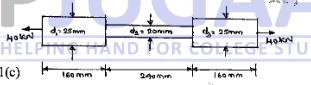
The bar shown in fig. Q1 (C) is tested in a universal testing machine. It is observed that at a load of 40kN the total extension is 0.285mm. Determine the "Young's modulus of the material.
Derive relation between Modulus of Rigidity. Young's modulus and Poisson's ratio.The bar shown in fig.
A steel rod is of 20m long at a temperature of 20°С. Find the free expansion of the bar,when the temperature is raised to 65°C. Also calculate the temperature stress produced for the following cases: i) When the expansion of the rod is prevented ii) When the rod is permitted to expand by 5.8mm. Take =12 x 10°C and E=200 GPa.
A load of 2MN is applied on a column 500mm x 500mm. the column is reinforced with four steel bars of 1 Omm diameter, one in each corner. Find the stresses in the concrete and steel bars. Take E for steel as 2.1 x 10⁵ N/mm and for concrete as 1.4 x 10 N4/mm2.
a. Define :
i) Principal plane
ii) Principal stresses.
Determine the magnitude and direction of resultant stresses on a plane inclined at an angle of 600 to major principal stress plane, when the bar is subjected to principal stresses at a point 200MPa tensile and 100MPa compressive. Also determine the resultant stress and its obliquity.
Two wooden pieces 100mm x 100mm in cross section are glued together along line AB as shown in fig. Q3(c). What maximum axial force 'P' can be applied if the allowable shearing stress along AB is 1.2N/mm2?
Define
i) Bending moment
Define:
ii) Point of contraflexure.
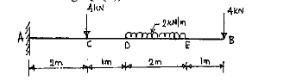
For the cantilever beam shown in fig. Q4(b), obtain SFD and BMD.
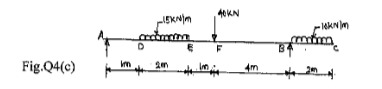
Draw the Shear force and Bending moment diagrams for the beam shown in fig. Q4(c).
a. Derive the equation of theory of simple bending with usual notations.
Explain the term:
i) Slope
ii) Deflection
iii) Deflection curve
A simply supported beam 8m long, carries two concentrated loads of 80kN and 60kN at distances of 3m and om from left end support respectively. Calculate slope and deflection under loads. Given E=2.0 105 MPa and I = 300 x 106mm.
State the assumptions made in the theory of Pure Torsion.
b. A hollow shaft of intenal diameter 400mm and external diameter 460mm is required to transmit power at 180rpm. Determine the power it can transmit, if the shear stress is not to exceed 60N/mm2 and the maximum torque exceeds the mean by 30%.
A solid circular shaft is to transmit 250kN at 100 rpm. If the shear stress is not to exceed 75N/mm2, what should be the diameter of the shaft? If this shaft is to be replaced by a hollow one, whose internal diameter is 0.6 times external diameter, determine the size and percentage saving in weight, maximum shear stress being the same.
a. Derive an expression for Euler's crippling load for a column with both ends fixed.
b. Compare the crippling loads given by Euler's and Rankine's formula for a column of circular section 2.3m long and of 30mm diameter. The column is hinged at both ends. Take yield stress as 335N/mm2 and Rankine's constant and E = 2 x 10⁵ N/mm². For 7500 what ratio of L/K, the Euler's formula cease to apply for this column?
Explain static indeterminacy and kinematic indeterminacy of structures with examples.
Derive an expression for strain energy stored in a beam due to bending with usual notations.
Explain any three structural forms with examples.
Determine the slope and deflection at the free end of the cantilever beam of span subjected to udl of intensity /unit length throughout the span. El is constant. Use moment area theorem.
Find the slope at support A and deflection at centre span of a simply supported beam subjected to loading as shown in Fig. 2(b). Use conjugate beam method. E is constant.
Find the vertical deflection at the joint for the pin jointed truss shown in Fig.Q3, by strain energy method. The cross sectional area is shown. Take E=200 kN/mm2.
Determine horizontal and vertical component of deflection at point 'C' for the frame loaded as shown in Fig. Q4 by strain energy method.
Using strain energy method, compute the deflection at mid span of a simply supported beam carrying a uniformly distributed load of kN/m. Assume an uniform flexural rigidity.
Derive an expression to find length of a cable subjected to uniformly distributed load throughout with usual notations.
A three hinged parabolic arch is loaded as shown in Fig.5(b). Determine the reactions at supports, normal thrust, radial shear and bending moment at left quarter span point.
Draw SFD and BMD for the propped cantilever beam loaded as shown in Fig. Q6(a). Use consistent deformation method.
For a rigidly fixed beam AB of span 5m carrying a uniformly distributed load of 10 kN/m over the entire span, locate the point of contra flexure and draw BMD and SFD. [Fig.Q6(b)].
Analyze the continuous beam shown in Fig. Q7, by three moment theorem. E is constant.Draw the BMD and SFD.
A two hinged parabolic arch of constant cross-section has a span of 60 m and a central rise of 10 m. It is subjected to loading as shown in Fig. 28. Calculate the reactions at supports of the arch, normal thrust and radial shear at 20 m from left support .
Distinguish between :
i) Ideal fluids and real fluids
ii) Surface tension and capillarity
Prove that the relationship between surface tension and pressure inside a droplet of liquid in excess of outside pressure is given by, P=
A 400 mm diameter staff is rotating at 200 mm in a bearing of length 120 mm. If the thickness of oil film is 1.5 mm and the dynamic viscosity of the oil is 0.7 N/m2 determine:
i) Torque required to overcome friction in bearing
ii) Power utilized.
Differentiate between :
i) Absolute and gauge pressure
ii) Simple manometer and differential manometer and
iii) Piezometer and pressure gauges.
What is the difference between U-tube differential manometers and inverted U-tube differential manometers? Where are they used?
A single column manometer is connected to a pipe containing oil of specific gravity 0.8. The ratio of reservoir area to the limb is 100. The liquid level in the reservoir is 300 mm below the centre of the pipe containing oil and level of liquid in the right liquid limb is 500 mm above the liquid level in the reservoir. Determine the pressure of liquid in the pipe. The liquid in the reservoir and right limb is mercury with its sp.gr. as 13.6.
Derive an expression for the depth of centre of pressure from free surface of liquid of an inclined plane surface submerged in the liquid.
Find the magnitude and direction of the resultant force due to water acting on a roller gate of cylindrical form of 4 m diameter, when the gate is placed on the dam in such a way that water is just going to spill. Take the length of the gate as 8 m.
Differentiate between the Eulerian and Lagrangian methods of representing fluid flow.
Show that streamlines and equipotential lines form a set of perpendicular lines.
In a 2-D incompressible flow, the fluid velocity components are given by u = x - 4y and V= -y-4x. Show that velocity potential exists and determine its form as well as stream function.
Describe venturimeter and find an expression for discharge through ventimeter.
The water is flowing through a tapering pipe having diameter 300 mm and 150 mm at section 1 and 2 respectively. The discharge through the pipe is 40 litres/sec. The section 1 is 10 m above the datum and section 2 is 6 m above datum. Find the velocity of pressure at section 2 if that at section 1 is 400 kN/m'.
A pitot tube is inserted in a pipe of diameter 30 cm. The static pressure in the pipe is 10 cm of mercury (vaccum). The stagnation pressure at the centre of the pipe recorded by the pitot tube is 0.981 N/cm². Calculate the discharge through the pipe, if the average flow velocity is 0.85 times the central velocity. Take Cd=0.98.
Distinguish between hydraulic gradient line and energy gradient line.
Derive an expression for loss of head due to sudden enlargement in a pipe line.
A pipe line of 0,6 m diameter is 1.5 km long. To augment the discharge, another pipeline of the same diameter is introduced parallel to the first in the second half of its length. Find the increase of discharge if f = 0.04 and head at the inlet is 30 m.
Define various hydraulic coefficients of an orifice and derive the relation between them.
Differentiate between a large and small orifice. Obtain an expression for discharge through a large rectangular orifice.
Water under a constant head of 4.5 m discharges through an external cylindrical mouthpiece of 50 mm diameter and 150 mm long. If Cc for the orifice is 0.6, find (i) the discharge in litres per second and ii) the absolute pressure at the vena antracta. Assume atmospheric pressure to be 103 m of water.
What are the advantages of triangular notch over a rectangular notch?
A right angle triangular notch is used for measuring a discharge of 30 lps. An error of 1.5 mm was made while measuring the head over the notch. Calculate the percentage error in estimating the discharge. Take Cd =0.62
A suppressed rectangular weir is constructed across a channel of 0.77 m width with a head of 0.39 m and the crest 0.6 m above the bed of the channel. Estimate the discharge over it. Consider the velocity of approach and assume Cd=0.623.
Briefly explain assessment procedure in the following activity.
i) Highway project Briefly
ii) Thermal power plants.
Write short note on :
Socio-economic impact assessment
EIA process in India
DEIA and FEIA
Environmental impact of Nuclear power plants
Environment impact matrices.
What are plane stress and plane strain problem? Explain with examples.
Explain briefly
i) Constitutive law
ii) The principle of minimum potential energy
iii) The Functional
iv) Body and Traction forces.
Explain briefly the steps involved Galerkin's method. Mention its application.
Determine displacement at loading point and the corresponding stress using Rayleigh Ritz method for a fixed bar at both ends as shown in Fig Q2(n).
Assume
Assume second order polynomial function.
Prove that , with usual notation.
With usual notation prove that
Apply virtual work principle.
Define local global and natural co-ordinates. Give exemples.
Mention the advantages and disadvantages of finite element analysis.
Mention the steps involved in finite element analysis.
Determine the direction cosines, element displacement and elemental stress for the turn element shown in Fig Q4(c) Fig.
@CC For Fig Q4(c), E = 300x103 N/mm', A = 100mm2
Element displacement
Define :
i) Isoparametric
ii) sub parametric
iii) super parametric elements.
Determine Cartesian co-ordinates for the point shown in Fig Q5(b). ,
Define "shape function" plot the same for
i) 3 noded bar element-one node at mid point
ii) 3 noded CST element
iii) 4 noded Quadrilateral element
[No derivation required, only plot]
Derive the shape function in natural coordinate for a CST element from fundamentals. Use the concept of parent element in natural coordination. Also plot the variation of shape function for all the nodes in CST element.
Mention the five conditions to be satisfied by the general shape function, explain any one.
(05 Marks)Obtain the shape function for all the nodes shown in Fig Q7(b) and for all the element using natural co-ordinates. Apply Lagrange interpolation function approach.
Write short note on
Brief history of finite element method
Software's used in finite element analysis
Hermitian polynomials
Pascal's triangle and its applications
Finite representation of infinite bodies.
Express the complex number
in the form a + ib.
Find the modulus and amplitude of 1 + cos+ i sin.
Find the cube root of 1 - i.
Find the nth derivative of eax cos (bx+c).
Find the nth derivative of
If y= sin_1 x, prove that
Find the angle of intersection of the curves
Find the nodal equation of the curve r (1-cos) - 2a.
Expand log (secx) upto the term containing x4 using Maclaurin's series.
If u = x3 - 3xy2 + x + ex cosy + 11 show that uxx + tyy = 0.
If prove that
Find , where u = x+y+z, v= y + z ,w=z.
Obtain reduction formula for where n is positive integer.
Evaluate
Prove that: i) and ii) (n+1) = n! for a positive integer n.
Prove that
Show that
Solve
Solve dy = 0.
Solve + y cotx =cosx.
Solved
Solve (D2 - 4D + 13)y = cos 2x.
Solve (D2 + 2D + 1) = x2 + 2x.
Find the angle between any two diagonals of a cube.
Prove that the general equation of first degree in x, y, z represents a plane.
Find the angle between the lines,
Prove that the lines,
are perpendicular
Find the shortest distance between the lines.
Find the equation of the plane containing the point (2, 1, 1) and the line,
Find the constant 'a' so that the vectors are co-planar.
If and then prove that is perpendicular to and also find
Find the volume of the parallelopiped whose co-terminal edges are represented by the vectors
Find the velocity and acceleration of a particle moves along the curve at any time t".
Find the directional derivative of x2yz3 at(1, 1, 1) in the direction of
Find the divergence of the vector
show that
Show that the vector field, is solenoidal.
Find the constants a, b, c such that the vector field,
Prove that L(sin at)=
Find L[sint sin 2t sin 3t].
Find L[cos3t].
Find the inverse Laplace transform of
Find
Solve the differential equation, under the condition by Laplace transform techniques.
Solve the differential equation, by Laplace transform techniques.
Describe standard penetration test as per IS:2131 guidelines. How to apply corrections to observed SPT-values?
Estimate the grand water table, given the following data. Depth upto which water is boiled out 18 meters. Water rise on Ist day = 0.95m, IIday = 0.86m and III day = 0.78m. Use Hvorselev's method.
Explain equivalent point load method of determining - at any point with in loaded area.
Point loads 64kN, 15kN and 21kN, 1.5m apart in a straight line at the surface of soil mass.Calculate the resultant stress produced by these loads on a horizontal plane one meter below the surface at points vertically below the loads and also half way (mid point) between them. The vertical pressure du to point load Q is given by Boussinesq's equation The value of IB are as follows:
Sketch the curve showing distribution of these resultant stresses at that level.
Explain with a neat sketch a method of locating the phreatic line in a homogeneous earth dam with horizontal filter.
List the applications of flow net. Discuss about the validate of Darcy's law in determining quantity of seepage.
An earthen dam is built on a impervious foundation with a horizontal filter under the downstream slope. The horizontal and vertical permeability of the soil material in the dam are respectively 4 x 10⁻⁵ m/sec and 1 x 10⁻⁵ m/sec. Full reservoir level is 20 meters above downstream filter. Flow net consists of 4 flow channels and 15 equipotential drops. Estimate seepage loss per meter length of the dam.
Distinguish between Coulomb's earth pressure theory and Rankine's earth pressure theory.
Describe Rebhann's graphical method of finding active earth pressure on a retaining wall.
Obtain an expression for factor against sliding in C- soil by the method of slices. Explain determination of factor of safety by method of slices method.
An embankment is inclined at an angle 38º and its height is 20 meters. The angle of shearing resistance is 15º and the cohesion intercept is 50 kN/m². The unit weight of Boy is 16.5 kN/m'. Find the factor of safety with respect to cohesion. Consider Taylor stability number = 0.08.
List the assumptions of Terzaghi's bearing capacity equation.
Calculate the ultimate bearing capacity of a 2 meter wide square footmg resting on a ground surface of a sand deposit with the following properties: i) Unit weight is 18.6 kN/m3; ii) Anglo of internal friction = 38o. Also calculate ultimate bearing capacity of same footing when the footing is placed at depth of im below the ground surface. Take Nq = 41.4, Nr = 42.2 for =38º Adopt Terzaghi's equation. Also calculate percentage increase in bearing capacity with increase in depth from surface to 1 meter from natural ground level.
Discuss about the components of settlement.
The soft normally consolidated clay layer is 18 meter thick. The natural water content is 45%. The saturated unit weight is 18 kN/m3. The grain specific gravity is 2.70 and the liquid limit = 63%. The vertical stress increment at the centre of the layer due to the foundation load is 9kN/m". The ground water level is at the surface of the clay layer. Determine the consolidation settlement of the foundation.
List and explain the classification of pile foundation base on function and material.
Discuss about the factors governing minimum depth of foundation as per IS:1904 guidelines.
A cross beam ISLB-350 @ 495 N/m is connected to a main beam ISMB-500 @ 869 N/m.The top of the flanges are at same level. The framed connection has the following details:
i) Frame angle - 2 ISA 150x115x10 @ 200 N/m.
ii) The connection between the cleat angle leg of 115 mm and web of the cross beam is 5 mm fillet weld of length 250 mm
iii) The connection between the cleat angle leg of 150 mm and web of the main beam is 8 mm fillet weld of length 250 mm.
iv) The clearance between cross beam and web of main beam is 10 mm.
Draw to a suitable scale:
Front view and
Side view with all details.
The design stiffened seated connection has the following details:
i) ISHB-300@630 N/m transmits an end reaction of 80 kN to the flange of column section ISHB-250 @ 547 N/m.
ii) Seat angle ISA 100 x 75 x 8 mm at 105 N/m, 100 mm along horizontal
iii) Stiffening angle 2ISA 90x90x8mm at 108 N/m
iv) Cleat angle at top ISA 75 x 75 x 8 mm at 89 N/m. Connect 2 - 18 mm dia in each leg.
v) Bolts connecting the stiffening angle with the column flange are 8-20 mm dia, HSFG bolts at a pitch of 60 m C/C, 4 bolts in each row.
vi) Stiffening angle are tack bolted.
Use 2 - 18 mm dia bolts.
Front elevation
Side view
A built up column is composed of 21SLC-350@388 Nm placed back to back at clear distance of 220 mm. The column is provided with single lacing system consisting of 60 ISF12 mm at 45º and is connected by a 20 mm dia bolt at each end. The channels are supported over a slab base 600x 450 x 50mm. The angles connecting column and base plate is ISA 100 x 100 x 10 mm and are connected by 2-20 mm dia on each leg. Draw to a suitable scale:
i) Sectional elevation. ii) Plan of slab base assembly with all details.
Draw to a suitable scale the elevation and plan of the column splice having the following details:
i) Bottom column: ISHB - 300 @ 630 N/m ii) Top column: ISHB-200 @ 400 N/m
iii) Splice plate: 8 mm thick iv) Bearing plate: 50 mm
v) Use 8-20 mm dia on each side of the joint in two rows of 4 bolts each for connecting flanges of the columns to flange splice plate.
Draw to a suitable scale :
Sectional elevation
Side view with details.
A simply supported welded plate girder for an effective span of 30 m and a udl of 30 kN/m and two concentrated load of 150 kN each acting at 10 m from both ends. It is fully restrained against lateral buckling throughout the span. Design the central section using thin web with K = 100 and end bearing stiffner. Also design the welded connection between flange and web. Take = 250 MPa, fu = 415 MPa and ultimate stress of weld =410 MPa. Also design curtailment of plate.
Elevation for full span with discontinuous line,
C/S at support and midspan.
Plan for full span with discontinuous line.
Design a simply supported crane girder for the following data. The girder is electrically operated. Take yield stress of steel is 250 N/mm2. Use 16 mm dia: Bolts of grade 4.6.
i) Capacity of crane: 250 KN
ii) Weight of crab (Trolley): 80 kN.
iii) Weight of crane girder excluding trolley : 300 KN
iv) Span of the crane girder = 18 m.
v) Minimum hook approach = 1.0 m
vi) Wheel base = 3.0m
vii) Span of gantry girder = 6 m
viii) Weight of rail section = 0.25 kN/m
ix) Take fy = 250 MPa.
Draw to a suitable scale showing all details:
i) Plan of G.G.
ii) Front view
iii) Cross section of Gantry Girder.
Congratulations! Your trial of
is now active.
Let's catch up on a Zoom call and I'll help you craft a killer career plan! Bring your own coffee.
Sourabh Bajaj





 and write the comparison equations in y and z directions.
 =1;
=1;  = -2;
= -2;  =4;
=4;  =2;
=2;  = -3 and
  = 1 all units are in KP Find the principal stresses and
check for invariance.
= 1 all units are in KP Find the principal stresses and
check for invariance.  determine: i) Magnitude of pincipal strains
 represents a stross function.
  for torsion problems.


 and
and


 Design the cross section and longitudinal slope of trapezoidal drain
assuming the bottom width of the trapezoidal section to be 1.0 m and cross slope to be 1.0
vertical to 1.5 horizontal. The allowable velocity of flow in the-drain is 1.2 m/sec and
Manning's roughness co-efficient is 0.02.
Design the cross section and longitudinal slope of trapezoidal drain
assuming the bottom width of the trapezoidal section to be 1.0 m and cross slope to be 1.0
vertical to 1.5 horizontal. The allowable velocity of flow in the-drain is 1.2 m/sec and
Manning's roughness co-efficient is 0.02. with usual notations.


 .viscosity
  of air, wind velocity V, diameter D and height H of the Chimney. By means of
  -theorem develop an expression for the resistance of the building in terms of these
quantities.
-theorem develop an expression for the resistance of the building in terms of these
quantities.
 , find Froude-number after jump.
  of runner, speed ratio= 2.09 and flow ratio =0.68,
  = 85%TS
  wires located 100 mm from the soffit of the beam. If the wires are
initially tensioned to a stress of 1100 N/mm2, calculate the effective stress after all losses,
given the following:
wires located 100 mm from the soffit of the beam. If the wires are
initially tensioned to a stress of 1100 N/mm2, calculate the effective stress after all losses,
given the following:
 1.6 ; Es = 210 kN/mm and Ec.=31.5 kN/mm2
 =0.35.
Determine the loss of stress due to friction at the centre of the beam.
=0.35.
Determine the loss of stress due to friction at the centre of the beam.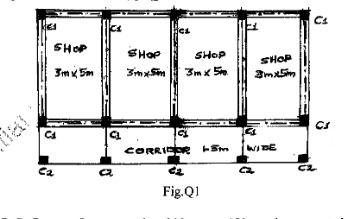
 =12 x 10°C and E=200 GPa.
 105 MPa and I = 300 x 106mm.
 and E = 2 x 10⁵ N/mm². For
7500
what ratio of L/K, the Euler's formula cease to apply for this column?
and E = 2 x 10⁵ N/mm². For
7500
what ratio of L/K, the Euler's formula cease to apply for this column? /unit length throughout the span. El is constant. Use moment area
theorem.
/unit length throughout the span. El is constant. Use moment area
theorem. 


 kN/m. Assume an uniform flexural rigidity.


 , with usual notation.
 Apply virtual work principle.

 shown in Fig Q5(b).
,
shown in Fig Q5(b).
, 

 in the form a + ib.
  + i sin
 .
.


 ) - 2a.
 prove that
 , where u = x+y+z, v= y + z ,w=z.
  where n is positive integer.


 and ii)
  (n+1) = n! for a positive integer n.


 dy = 0.
 + y cotx =cosx.

 are perpendicular

 Find the constant 'a' so that the vectors
  are co-planar.
 and
and  then prove that
  is perpendicular to
  and also find

 at any time t".

 show that
 is solenoidal.


 under the condition
  by Laplace transform techniques.
  by Laplace transform techniques.
 - at any point with in loaded area.
 du to point load Q is given by Boussinesq's
  equation
The value of I
equation
The value of I
 soil by the method of slices. Explain determination of factor of safety by method of slices method.
  =38º Adopt Terzaghi's equation. Also calculate percentage increase in
bearing capacity with increase in depth from surface to 1 meter from natural ground level.
=38º Adopt Terzaghi's equation. Also calculate percentage increase in
bearing capacity with increase in depth from surface to 1 meter from natural ground level.
 Front view and
 Side view with all details.
  Front elevation
 Side view
 Sectional elevation
 Side view with details.
  = 250 MPa, fu = 415 MPa and ultimate stress of weld =410 MPa.
Also design curtailment of plate.
= 250 MPa, fu = 415 MPa and ultimate stress of weld =410 MPa.
Also design curtailment of plate.